
This is a negotiation — not a form with a total.
Four phases, and each one needs every founder before the project moves on. That is what stops the hardest part of the conversation being quietly skipped.
All four phases, on our standard weights. No card required.
The whole run, and the gate on every move
The four phases are the work. Finalized and archived are what a project becomes. Beside each arrow is the condition the app checks before it will make that move — there is no override, no majority and no time limit.
1. Setup
One founder creates the project and invites the others by email. Everyone signs in to their own account — there is no shared login, and nobody fills anything in on anyone else’s behalf.
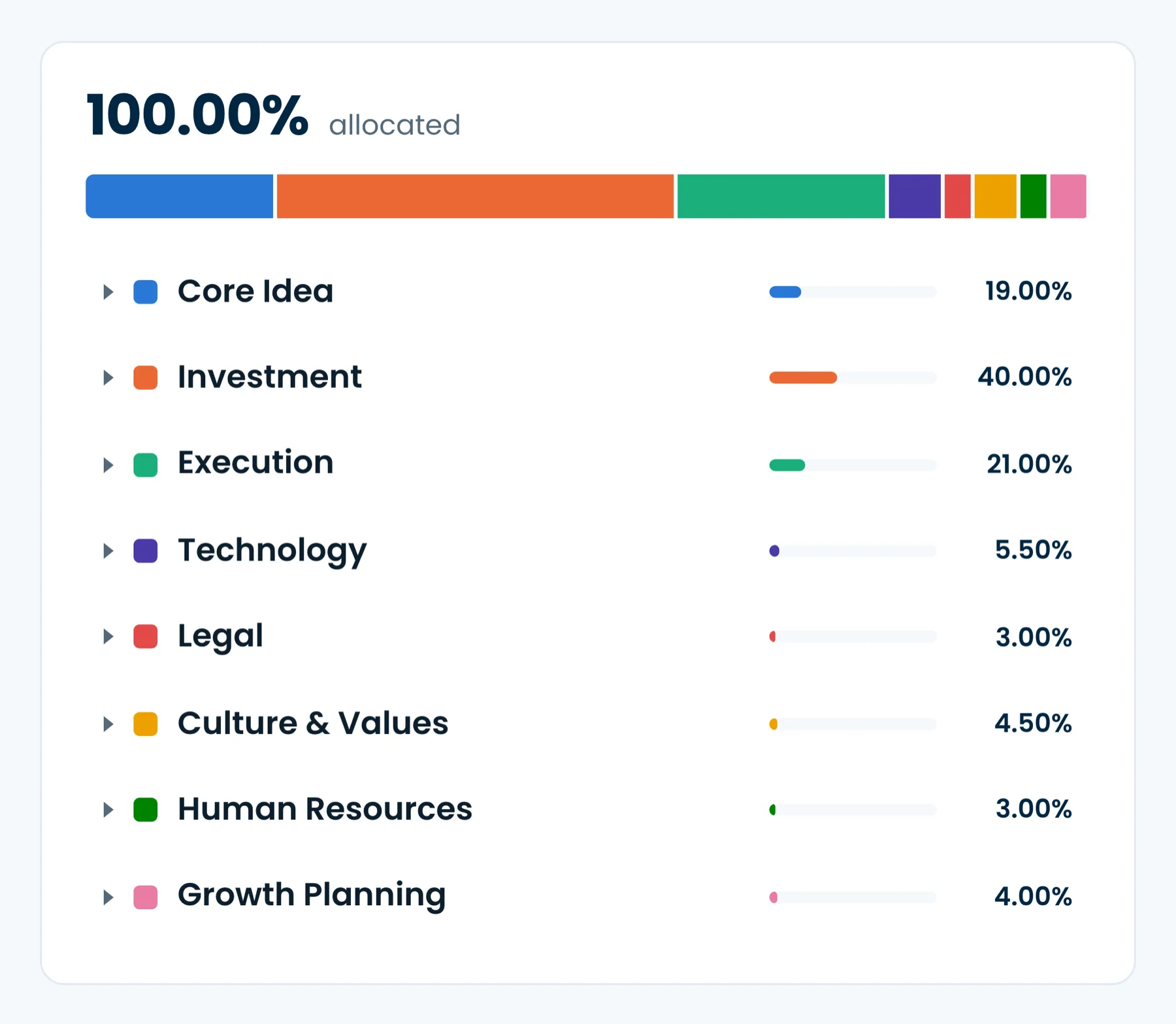
Every project starts from the same standard allocation, covering what most businesses actually run on:
- Investment40%
- Execution21%
- Core Idea19%
- Technology5.5%
- Culture & Values4.5%
- Growth Planning4%
- Legal3%
- Human Resources3%
A project cannot move forward with one founder in it, and the weights have to total exactly 100% before anything starts. Founders can only be added up to the point the questionnaire opens.
2. Negotiation
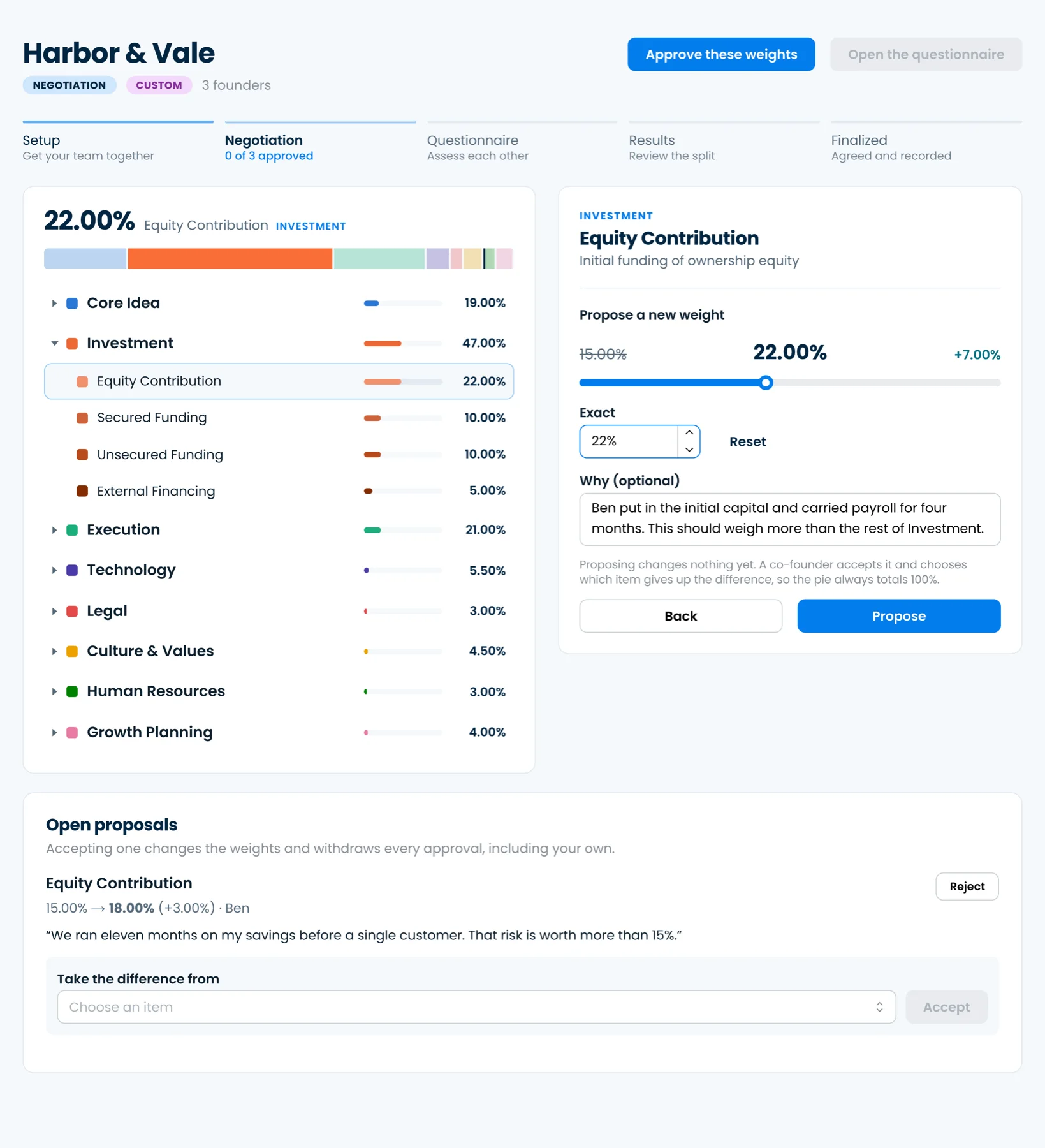
Before anyone is scored, the team agrees what counts and how much. A weight cannot simply go up: a change is an exchange, and it costs another item exactly what it gains.
The questionnaire will not open until every founder has approved the current weights. Approvals are counted against a fingerprint of the numbers, so moving one silently withdraws consent rather than carrying it forward.
3. Questionnaire
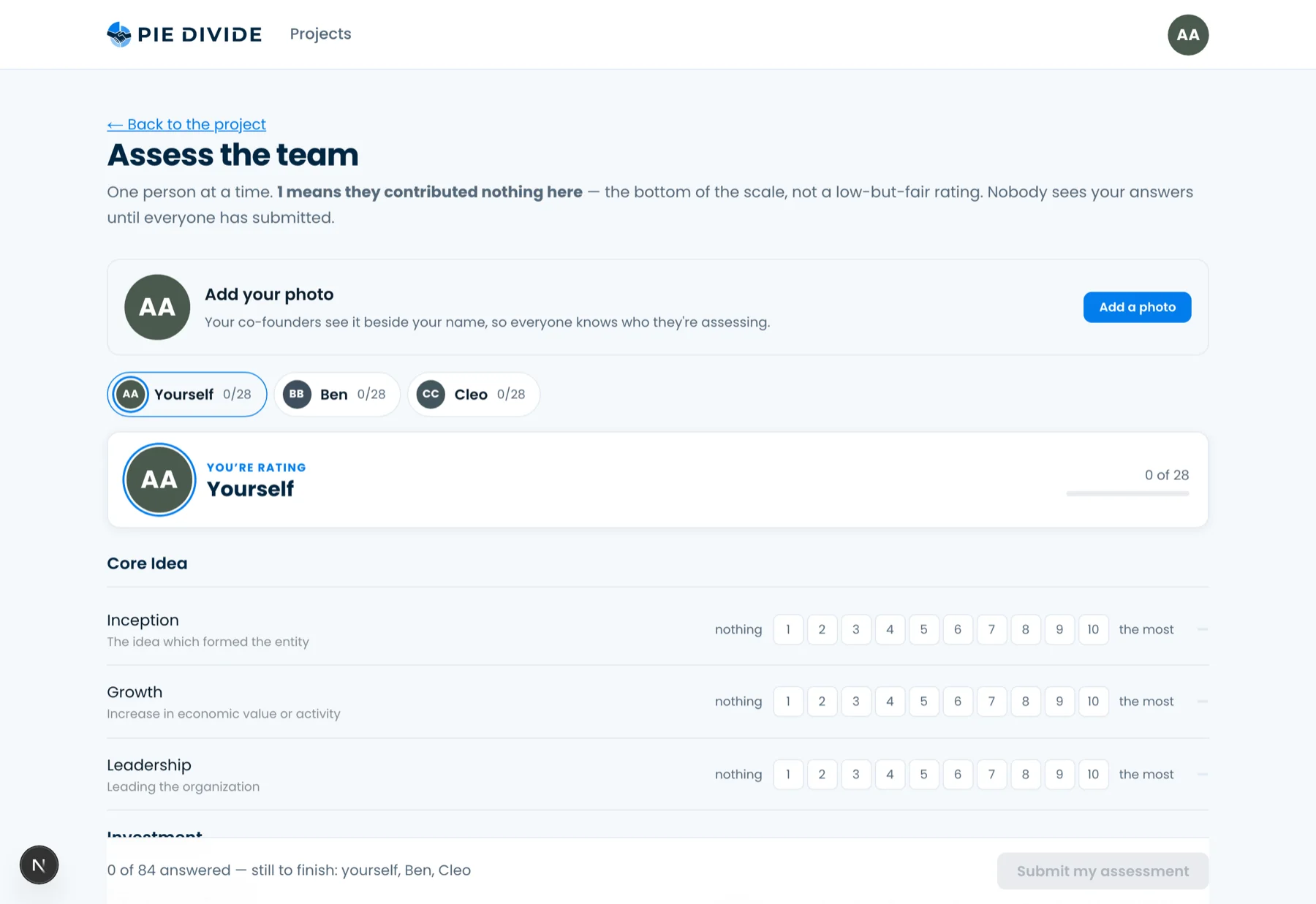
Each founder scores themselves and every co-founder on every item, from 1 to 10. You cannot see anyone else’s answers while you work, and you cannot submit a partial response — the system checks your answers against the full set of people and items before accepting it.
No result is computed until every founder has submitted a complete response. Partial submissions are rejected outright rather than quietly counted as zeros.
4. Results and approval
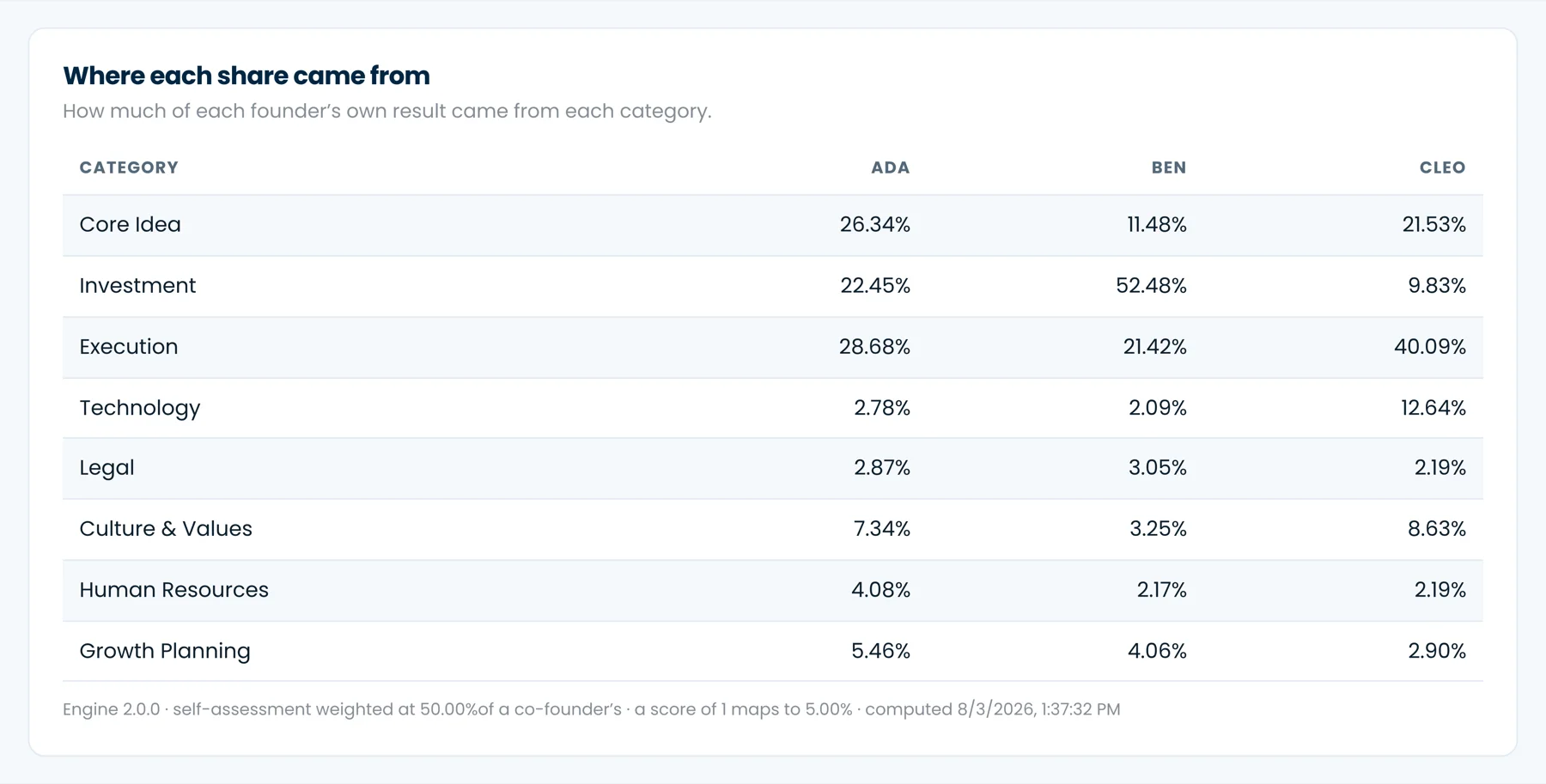
Once everyone has submitted, the split is computed once and stored. You see each founder’s percentage and how each category contributed to it, rather than a single number with no explanation.
The split is not final until every founder approves it. Anyone can dispute instead, give a reason, and reopen a fresh round — and the earlier result, along with the record of who approved and who objected, is kept rather than erased.
Nothing finalizes while a dispute is open, or before every founder has approved. There is no majority and no time limit that decides it for you.
Walk all four phases free
With your real co-founders, on our standard weights. Roughly an hour, and no card.
What you have at the end
A decision you can show someone. This is the part a calculator cannot give you, and the part that matters if the agreement is ever questioned.
The split itself
Each founder’s percentage, and the contribution of every category behind it.
How you got there
The weights you agreed, who proposed what, what was accepted and rejected, and the rounds you went through.
Who agreed, and when
Every approval, timestamped, against the exact version of the weights that was on screen at the time.
The questions teams actually ask
Including the ones where the honest answer is that this is not what the product does.
How does this work with vesting?
It sits before it. Pie Divide decides what the percentages are; vesting is a term of the shares your lawyer papers afterwards, and it applies on top of whatever split you agree here. The app does not model a vesting schedule, track a cliff, or know whether you have one. The checklist you get after finalizing raises the question and points at the professionals who answer it — it does not answer it for you.
What if a co-founder simply refuses to approve the result?
Then it does not finalize, and nothing works around them. There is no majority, no time limit and no override: the project sits at the results stage until every founder has approved. That is the design rather than a gap — a split three of your four founders agreed to is the exact outcome this product exists to prevent. What you can do is dispute and run another round, go back and renegotiate the weights if the disagreement turns out to be about those, or archive the project.
How many rounds can we run if we keep disagreeing?
As many as you need. Disputing opens a new numbered round rather than wiping the last one, so the previous result and the record of who approved it and who objected stay in the project beside the new one. You never restart from a blank page. If the argument is really about what should count rather than about who did it, you can reopen the negotiation instead of running the same questionnaire again.
Can co-founders see how I scored them?
No. You only ever read back your own answers — while the round is open and after it closes. What everyone sees at the end is the split itself and how much each category contributed to each person's share. Nobody is shown who rated whom what.
Can we add a founder part-way through?
Up until the questionnaire opens, yes. After that, adding someone would mean every founder who had already submitted had assessed an incomplete team, so the app refuses. If a fifth person joins late, reopen the negotiation — that takes the project back to a phase where invitations are allowed, and the round starts again with everyone in it.
Does this work for a team outside the United States?
The process itself assumes no country. Weights, private peer assessment, unanimous approval and the record behave the same wherever the company is, and there is no field asking where you are incorporated. Two things are US-shaped and we would rather say so than let you discover it: the checklist offered after finalizing is written around US formation — EIN, state filings, the 83(b) window — so parts of it will not apply to you, and the one-off upgrade is priced and charged in US dollars.
Is what we agree here legally binding?
Pie Divide is not a law firm and does not give legal advice, so this is a description of the product rather than an answer about your agreement. What the app produces is a record: the weights the team agreed, who proposed what and why, and every approval timestamped against the exact version of the numbers that was on screen at the time. What it does not do is draft, sign or file anything. It is not a founder agreement and it does not issue shares. Turning the split into shares and a signed agreement is a separate step with a lawyer, and it is the first thing on the checklist you get when you finalize.
Run it once and see.
The free version walks all four phases on our standard weights — enough to know within an hour whether this is worth paying to make your own.